
Episode 176: How To Emerge From The Goo To Become A Butterfly With Josh Allan Dykstra

Major career and life transformations are a necessary, messy process that teaches us how to emerge from the goo to become a butterfly. Optimistic futurist and serial entrepreneur Josh Allan Dykstra transparently shares his life story and career journey, detailing his path from his South Dakota upbringing and rockstar music aspirations to his eventual pivot into consulting and launching Hello Tomorrow, a future-focused organizational design studio. He discusses how a deep fascination with leadership, first observed in his family, guided his evolution when the music industry was not the right fit, offering valuable lessons on how to lead yourself through significant change. Josh reflects on the importance of timing, embodiment, and listening to his gut, key leadership principles that inform his career, all of which now guide his current focus on his family and future business endeavors as a keynote speaker and author.
---
Watch the episode here
Listen to the podcast here
Episode 176: How To Emerge From The Goo To Become A Butterfly With Josh Allan Dykstra
Welcome to this episode of the show, where I interviewed Josh Allan Dykstra. He is a future of work keynote speaker and the world's foremost practitioner on human energy. He spent the last couple of decades building five companies and working with some of the most iconic brands on earth. His clients have a combined employee count of over a million people. Josh is also an author, TEDx speaker, and Founder and CEO of The Work Revolution, where they fight for the future by fixing work.
During this interview, Josh Allan Dykstra shared his life story and career journey, starting from his upbringing in South Dakota to his transition from music to consulting, and eventually, technology, including his experiences with love work and various business ventures. In his discussion on his early aspirations, his music, his fascination with leadership from observing family members, and his eventual shift to consulting and technology after realizing the music industry wasn't the right path for him, Josh reflected on his career evolution.
He emphasizes the importance of timing, embodiment, and listening to his gut, while sharing his current focus on family and his business. I hope you enjoy his stories, especially his stories on recreation. We go through these seasons in our life where things are going well and then not so well, and then having to recalibrate. Josh's story is such a great example of that. I hope you enjoy this and take away what you need for your own life and work.
‐‐‐
Welcome to this episode of the show. I'm excited to interview Josh Allan Dykstra. Josh, do you want to give a little intro on yourself before we get started on your story?
Sure. Thanks for having me. I am an optimistic futurist and a keynote speaker. I've been a serial entrepreneur. I started a whole bunch of different kinds of companies, all in the service of making work not suck for humans. That's been my banner or mission for the last couple of decades. When I closed my tech company, I thought, “I want to do something a little different,” so I'm getting back into the world of speaking and writing another book. I am trying to use my organizational expertise to help create a better future for everybody.
South Dakota Roots: Building Houses And An Entrepreneurial Universe
I love it. I'm sure we're going to have a ton to talk about. Let's start from your beginnings. Where did you grow up? What did your parents do? Did you have siblings? Give us a little background on yourself.
I grew up in the literal middle of nowhere in South Dakota, in a town of 1,311 people. We were surrounded by farmland on all sides. My parents were not farmers, but I have lots of relatives who still are. My dad built houses. He was a combination of architect and builder, because you do everything in a town of 1,300 people. My mom, in those days, helped him out with that business. I grew up in a very entrepreneurial universe. That has always been in my blood.
Did you help in the family business much when you were younger?
I did. I got pulled into sweeping floors and cleaning up after Dad. Once I got a little bigger, he even let me start doing some other projects. I remember doing some roofing as a teenager, which is not work that I particularly found energizing, especially in the South Dakota summer. I did get pulled into some of that. That was, I think, my first job. It was working with my dad, building houses.
When you were with your dad, what were your observations as a child of watching him at work and your mom?
I always had a sense of hard work ethic, a sense of responsibility, a sense of excellence, quality and care, and paying attention to details. Taking care of people was also a big part of it. My parents would own a couple of other different businesses growing up, including a little store that they opened up downtown. Everything that I remember my folks doing was done with a lot of love, art, and intentionality.
Classical Training & Rockstar Dreams: The First Career Path
Were you into art?
I was always an artsy kid. I was a musician. I can't remember not playing the piano. Apparently, I wrote my first song on the piano when I was four. I started getting classically trained on piano when I was five and carried that all the way through high school. I grew up a lot with music and art in my universe. That was the big art form for me.
What did you enjoy about it, or not enjoy about it?
I loved it. For a long time, I thought it was going to be my career. When I came out of college, I thought I was going to be a performing musician, i.e., a rockstar. We can talk about that if you want. What I remember about the music back then, for me, was that there was something that made sense in my body with music. It computes for me. I always loved being on stage, too. I love performing for people. Do you remember back in the ‘80s in the US, we had shopping malls with music stores in them?
I worked in them. I loved it.
When I was a kid, we'd go to the mall. I would be the eight-year-old kid drawing a crowd in the music store, playing the piano. I'd be like, “That's cool.” I always had a jolt of energy from that. With music, I loved the technicality of it. I was classically trained. I loved the technique. I also had training in ear training, chords, chord structures, and different ways to play by ear. It was a place of improv for me and a place of interacting with the environment in much more of an organic way, not just in a read-the-notes-on-the-page kind of way. It was both of those things for me.
Baldwin used to have classes where you had earphones and big headphones on. There'd be eight little kids in a class where the teacher could plug into your piano. I started violin in fourth grade. I get how you feel in that. Violin fit me better. I always felt overwhelmed by the piano for some reason.
There are a lot of fingers all at the same time. With many other instruments, you're either bowing with one hand or strumming with one hand. With the piano, it's all your fingers all the time. I get that.
It was the size of it. I loved the violin as a part of me.
That's true. It's a massive instrument.
How did you choose the piano?
My grandmother, my mom's mom, taught piano. I was surrounded by pianos growing up. They were in all the houses that I was in. My parents had one. When I’d go over to my grandparents' house, they’d have one. I started playing it, and they were like, “This kid seems to like doing this. We should get him some lessons.” That's how I assumed that happened.
When you were little and dreamed of what you were going to be doing in life, that's what you thought you were going to do.
Maybe. The musician was probably in there. The other thing, though, was that I was watching my dad draft houses, doing the architecture side, and I thought that looked cool, too. An architect was in my awareness as an interesting thing. My third choice probably would've been president.
The Fascination With Leadership: College, Architecture, And Ambition
What did you end up going to college for?
I ended up studying a number of things. It was a liberal arts degree with an emphasis in music. I ended up getting a music minor. I also had a study in leadership. I started getting fascinated by leaders in high school.
That’s the president thing?
Maybe. There's something about the way leaders help the people around them do things that they didn't think they could do, and how great leaders elevate everything around them. I still find that fascinating and compelling.

Leadership Lessons: There's something about the way leaders help the people around them do things they didn't think they could do. Great leaders elevate everything around them.
What started you? Was there a certain leader in particular who started you on that journey?
I'm not sure. The president started way earlier in my consciousness, and I don't honestly know where that came from. I've often wondered about this. That almost crazy level of ambition, how does that get implanted into a child? I have no idea. Why would I think that? There’s something peculiar. I don't know why you would think, as a kid, that you want to run a country. That seems ridiculous. For whatever reason, it was always in there, this fascination with how some people lead other people to do great things. I don't know why, honestly, but I think it's very interesting.
You mentioned earlier about watching your parents and how they took care of people and elevated them. Are there some examples from them that stuck with you?
I think that's true. I grew up with all of my grandparents on both sides living close by, so I got to know them very well. My mom's dad was a pastor, so I got to see him lead congregations. Some of this probably got in there from him. He always thought I would grow up to be a pastor of some kind or a minister. From my perspective, the work I do isn't very different. I’m trying to inspire, bring people into a better future, and do all the things that I do. Maybe he was right, in a way. There were some grown-up examples in my life that probably modeled the way for good leadership.
Quarter-Life Crisis: Why Being A Rock Star Was Not The Right Fit
What did you want to do with those two degrees?
I thought I was going to be a rock star. In high school, I started picking up more instruments other than piano. I taught myself guitar. Even in middle school, I was in the jazz band, playing trumpets and stuff like that. In college, I picked up even more instruments, more guitars, and different kinds. After college, I started playing the drums.
I got to be able to play about every instrument you'd need to make an album. I thought, “I'm going to go be a rock star.” I started writing songs. Music is a special way to impact the world. I thought I was going to do that. I got a manager, and we moved to Los Angeles. I shopped the labels, did all the gigs, and started making albums. It was an interesting time.
After being in LA for about six months or so, I realized that I could not be a rockstar for one reason, mostly, which is that I'm not a night person. The energy didn't line up. It’d be like, “You're going on at 11:00,” and I'd be like, “Going on what?” The only thing I am going to do at 11:00 is go to my bed. That's it. It didn't work with my circadian rhythm. I was like, “I need to find a different way to live my life.” I wanted to do music, gave it a shot, and realized it wasn't going to be for me. I had my quarter-life crisis, like, “What the heck am I going to do if I'm not going to do music?” At least for the better chunk of high school and college, I thought I was going to be a musician. I didn't have a Plan B.
Sometimes, you think something that you have as a hobby would be great as a career, but when you turn it into a career versus a hobby, you lose the enjoyment or some of the fulfillment that you get from it. Did you find that when you were starting to take it more seriously?
I know what you're talking about. For me, there was the element of the business side of music that I did not care for. I would see some of my friends who are some of the most talented musicians that have ever lived, honestly. You will never know them.
Isn't that crazy?
That started to drive my soul crazy. The business of music doesn't promote the talent of music. It's something else.
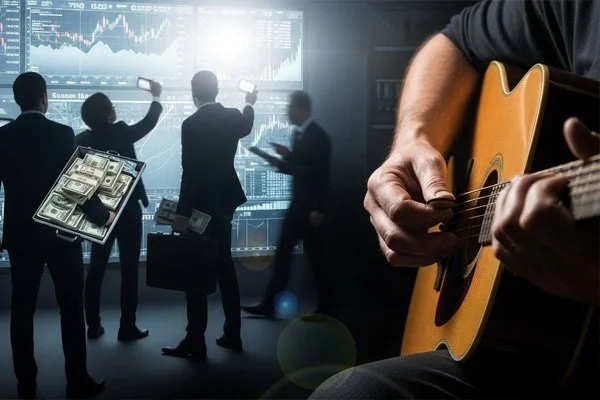
Leadership Lessons: The business of music actually doesn't promote the talent of music.
Do you know?
There are a lot of other factors, but it isn't talent. It isn't even hard work. That started to grate on me. I'm a person who's willing to work my butt off, but not for some sort of luck where maybe you'll be able to pay your rent someday. That never worked for me. That was part of the reason I was like, “I need to find something else also.
How did you pivot? What was the process?
It was a dark night of the soul for me, honestly. There were a couple of years there where I was a miserable human. God bless my wife at the time for helping me through that. It was a lot of soul-searching. It was a lot of job searching. I went back to school. I got an MBA in executive leadership. I'm not a finance brain at all, but leadership is cool. I went back to school and did that. That helped me. At that point, I was like, “I've got some sort of direction that I want to do something in the universe of work.”
I started to hear of this field called consulting. I was like, “I'd never heard of this.” For whatever reason, it was not in my awareness at all as a kid and as a young adult. I started to learn about this as, “There's this field of these consultants. They write books. Sometimes, they get on stages and speak to people. People pay them for their ideas. That sounds pretty neat. Maybe I should try to do that.” I went back to school and got this degree, going in that direction, not knowing exactly where it was going to take me.
I got out of grad school in 2009, which many folks will remember as the center of the great financial crisis. I'm like, “I got a shiny new degree. Do you want to hire me?” and it's crickets. I couldn't make anything happen then. Fortunately, my friends from grad school started hiring me as a consultant. They were like, “Come help us in my company. Help us do this project. Help us work on this culture thing, this leadership thing, or this strengths thing.” I started on my own in 2010, and I've never done anything else since then.
Building LoveWork: The Challenge Of Launching A Bootstrap Tech Startup
You said that you had owned a technology company. How did that end up happening?
For the first decade or so, I was a consultant and workshop facilitator guy. I would do team building workshops and consulting projects. I also published a book in 2012. I started doing a little bit of speaking. I got to do a TED Talk in 2018. I'm in Denver now, but I was in Los Angeles doing the music thing and then not doing the music thing. I stayed in LA for almost a decade and started my business there.
We moved to Denver with two kiddos. I have two girls. We moved here when the big sister was 2, and the little one was 4months old. It was crazy when we first moved. We moved across the country with two little babies to pretty much a brand new place for us, in a lot of ways. We'd been here before, but Denver changed a lot in a decade.
I wanted to get off the road after moving here. I traveled a lot for the first couple of years, doing the things I'd been doing, but then I got burned out. I've been doing about a decade of business travel. I was like, “I want to be home with these little kiddos, help out a little bit with that, and be there with them.” I built a different business where we trained coaches and consultants. I did that for a couple of years. We trained on somebody else's product, and that started to become tricky. I was like, “I want to build my own thing. I want it to be technology.”
This would've been 2017 or 2018, somewhere in there. I was like, “I want to start building technology. I don't know what to build. I don't know how to pay for it.” I'm a nerd. I like technology, but never built a tech company before. We decided to build a product that ended up being called Love Work. This was a product that reinvented how leaders and teams do leadership development and team building. It was very cool. It was effective. It worked well. I did that from 2019. We launched it in the fall of 2019, about 6 months before the pandemic. We kept it going until we ran out of cash, and I closed it down.
Key Lessons From LoveWork's Demise: Partners, Bootstrapping, And Venture
What did you learn from doing it?
Many things. I learned exponentially more from its demise than I would have from its success. A couple of things. I learned the importance of business partners. This was a very challenging experience. We had some betrayals in our leadership team over those 5 or 6 years. That was hard. It was hard emotionally and organizationally. The importance of choosing business partners properly. I had one business partner who stuck with me the whole way, and that was amazing. He was like a rock. I got to see both sides of not good choices and good choices. That was a big one.

Leadership Lessons: We learn exponentially more from the demise than the success.
I learned a lot about how to build technology. That's its own kind of beast. I always built bootstrap service-based businesses prior to this. Building a tech-based product business is very different. I thought I could bootstrap as I did my other businesses, and it didn't work. That was pretty challenging. I learned a lot about raising money and the financial side of these things. I learned the financial side of startups, venture capital, Angel investors, and that whole universe that I didn't know anything about before. That was all interesting.
The other thing I learned, too, is when to let go of things. I hung on longer than I maybe “should have.” I thought I was doing the right thing by trying to keep it alive and hanging onto it. It ended up pushing me into having to file for bankruptcy. I held onto it longer than I maybe should have, but all these things we don't know until we run up against them.
What's interesting is you've been teaching leadership and culture, and leadership was your number one lesson on picking the wrong people. What would you do differently as far as choosing the right leaders?
We did have both. The thing to notice is that it's remarkably difficult. You can make good choices on the one hand, and then there are things you don't see. We all have blind spots. There are things that other people aren't telling you, or maybe they're not being honest with themselves. Some of this stuff is not completely unavoidable, but maybe it is. I don't know.
The leadership lesson there for me is to be thoughtful and cautious about these things, but also to be gracious and kind to ourselves about these things. We don't know it until we do. We don't understand what narcissistic behavior is until we encounter it. Before that, it’s just words on a page. It's a concept that is disconnected from reality. Once you experience it, it's like, “That's what that is. That's what that does. Now I can do it better in the future.”
Some of the lessons here are to be cautious, be thoughtful as much as you can, and allow space for yourself to learn as you encounter things that you didn't expect to. I did not expect this to happen. I did not expect this to push me into bankruptcy. I didn't expect these things to happen. There is some sort of grace I can give myself to say, “I can learn from that now, do better next time, and do things differently in the future.” That's where I've come out the other side, thinking about it.

Leadership Lessons: Be cautious, be thoughtful, and allow space for yourself to learn as you encounter things you didn't expect.
There's so much more research out there about narcissism. You get fooled for a while until it comes out. Once it's out, it's out, until you realize, “This does not feel right.”
That's right.
Entrepreneurial Lessons: How To Know When To Let Go Of A Business
The other thing that you said is when to let go. That's an important piece for any entrepreneur. I'm a CPA in my background. A lot of times, as an entrepreneur, you're so invested. It's like your right arm. I try in my head to say, “If I were my client, what would I tell my client to do right now?” It is so I can separate myself from the business, because it is hard. You've put so much effort and your own money in. There's so much that isn't exposed to the outside world because you've got to have a brand and what you want people to buy from you. Where is that lesson falling for you when you look back?
The letting go lesson?
Yes.
I want to think that I would be wiser next time moving forward. I think I am. I think I would be. I have a better sense of knowing the things to hang on to and what things are not less important per se, but there are non-negotiables, and then there are other things that can be more malleable or flexible. I've whittled down the things that are non-negotiable.
There are things there that are crucial to me. I can be more flexible about these other things as I'm building a new company, as I'm rebuilding my life in a lot of ways, or as I'm rebuilding my career in a new direction. There’s all this stuff that I didn't expect to be doing before. I thought I was building a billion-dollar tech company a couple of years ago. I'm in this place where I'm rebuilding. I'm much more discerning.
What does that mean to you? More outlets?
I'm more thoughtful about what it is that I need in my life. It’s not that I was entranced by the idea of being a tech CEO billionaire. That's a cool thing or a cool aspiration, but I did want to build something that was hugely impactful. I wanted to build something that could impact millions of lives. I still have those ambitions.
What I've learned or what I'm trying to pay more attention to is more of a divine timing kind of thing. It’s the spiritual side of it. I am paying attention to the larger current of life, however the audience wants to think about it. I don't tend to be very specific on the spirituality part of it, but there's something spiritual here that we can be part of. There's a possibility for us to be a part of this larger capital-esque story of what's unfolding in the world and the universe.

Leadership Lessons: Pay attention to the larger current of life.
I'm trying to pay more attention to that, which, to me, means a lot more embodiment and a lot more paying attention to how it feels in the gut and also my spirit. My whole body, and maybe it's that I'm getting older, but I have more aches and pains everywhere. I do pay more attention to everything, how it feels in my body, and where it's showing up. It has become a practice of mine. That's part of the discernment.
Part of the more external discernment might be how I'm rebuilding the company. I'm being lean, focused, and small. I'm not trying to build the massive empire that I was before, at least not yet. I'm not trying to build that again immediately. There's more discernment there, too. I am letting things unfold more in the timing of the way that things feel like they're supposed to.
Do you think there's an element of letting ego go?
Someone could go through what I went through without letting go of some ego. This has been hard. It's been a brutal process. I've been thinking of it and talking about it with friends in the language of the chrysalis metaphor. There's a point in the chrysalis where the caterpillar goes in the chrysalis and turns into complete goop. It's called histolysis. In that phase, the caterpillar is goop. That's been the last few years of my life. That's what I felt like. Josh is like a pile of goop inside this transformative shell. I'm being reconstructed, and I’m not a total goop anymore. That was a deconstruction of the ego.
Alignment And Experiment: Rebuilding A Career After The Chrysalis Phase
How are you settling in to being able to make sure you're aligned with the work that you're doing and its impact?
Everything I'm doing is very much an experiment. I'm trying to follow the clues. I'm trying to take one step after the next. I’m trying to pay attention to what's working, and I'm trying to pay attention to where my energy is. Where do I feel energized? When I do things, and I feel good, powerful, and strong, and I’m like, “I should do more of that,” that has become a guiding light for me. It has also become a question of what the world needs. I’m trying to educate myself in the cycles of history, where I think we are in the cycles of history, and where things go next.
I tend to think in these big systems. I'm a systems thinker. I think in big, structural, societal systems and organizational systems. That makes sense to me in a very similar way that music does. How do I help make sense of that for others who maybe don't hear the music exactly as I do? Maybe it doesn't make sense in the way that it does to me.
“How can I make what's happening in the world make more sense for others?” has become my mantra That is guiding where I'm going. It is an experiment. I don't have anything like the stable career that I used to have. I very much feel like I'm being born into some new kind of animal, and it's not formed yet. We will have to talk again in a year and see what kind of butterfly I am because I don't know exactly. I think I have an idea. I'm running a bunch of experiments going into 2026. It's still all very much a work in progress at this moment.
For everyone. It's where your comfort level is. Do you get to play music?
Music is playing constantly in my universe. I'm very lucky and grateful that both of my girls love music. They're musical theater queens, both of them. That's a delight for me, except for the chauffeur part. Mostly, I'm a chauffeur for different rehearsals. They're 10 and 12. They're in different theater companies on different sides of the city, so mostly, I'm a driver.
We listen to a lot of music, sing a lot of music, and play a lot of music. They're doing music lessons, and they're in these theater productions all the time. I get to play a little. My mom got a piano. That's going to encourage me to play when we go visit them. It's still a major part of my life and something I want to do more of again in the future, once the business thing calms down a tiny bit.
My journey with it is that I stopped for a long time with my career, but then my kids started playing guitar, drums, and singing. I learned the bass guitar so I could round them out. We had some family events. Since they graduated from high school, my older son DJs. I've picked back up the violin, but it's the electric violin, and playing a rock band.
Good for you. That's great.
Bringing it back into your life might look different than before, but anyway, you can even enjoy it with them.
I am open to that. One of my bucket list things is to learn how to play jazz piano. I’ll put that out there in the universe in case they want to do that.
2026 vision.
Maybe not ‘26. Maybe ‘27. It’s on the calendar somewhere in the future.
Rapid Fire & Final Encouragement: The Winter-To-Spring Season Of Change
I’d love to ask you some questions. I like to ask some Rapid-fire questions. You pick a category. Family and friends, money, spiritual, or health?
I feel like health. That's the one that scares me the most, so let's do that.
Things or actions I don't have that I want to have as far as my health.
A couple of things. I want to build a better diet. That's a big one for me. I'm not a fan of Cookie, so this is not something I want to do. It presents a challenging conundrum for me. Diet is a big one. I'm doing okay with an exercise routine, but I'd like to ramp that up more this coming year, also. I had knee surgery in 2024, so I've had a lot of recovery in 2025. I feel like I can get back into things that I want to do more. More yoga, maybe. It has been a crazy year.
Things or actions I do have that I want to keep as far as my health.
I think I do a pretty good job. I am doing a regular ten-minute workout every morning, and that feels good. Other things that I do that I think are good for my health are taking breaks when I need to. I'm pretty good about that, going to take a rest or take a walk, and noticing when I need a break. Another thing I'm pretty good at is knowing how to find some solo recharge time. During the pandemic, I grew very fond of taking baths. That became my decompress, stress-free space, and I kept it going since. I try to do that fairly regularly. It's solitary and quiet. The kids aren't in my face. That’s a good place for me to decompress. I'm pretty good at that, too.
Things or actions I don't have that I don't want to have as far as my health.
Can I say any health problems I don't have?
Yeah.
I have some back pain. That's probably going to be your next question. I don't want any more aches or pains. That would be fine. I'm also a person with a bit of health anxiety. That’s something I've contended with over the years.
What does that mean, health anxiety?
For a long time, I called myself a borderline self-diagnosed hypochondriac. I'm not a hypochondriac. I've never been diagnosed. I'm just on the edge. I have ruminating thoughts about diseases and things. Honestly, the pandemic was horrible for this, but it also forced me to confront it, so it turned out to be a good thing. I developed some tools to deal with my health anxiety in a much more constructive way, coming out of the pandemic.
If I am feeling some ache or pain, I try not to look it up online because I think that's what it is.
Never do Dr. Google. Don’t do it.
Every Doctor hates Dr. Google. Anything that we didn't discuss that you want to re-emphasize to the audience before we close up?
Thank you for this space. This is a lovely journey to be able to talk about some of these things. Some of these things I haven't talked about before, which is always fun.
Thanks for doing it.
I do a lot of these kinds of things. It's fun to talk about new things. I appreciate your questions. I don't know what else I would say. I would like to encourage everybody. I do think we're in a season of massive change. I don't think that's probably surprising to anyone. I've come to believe that this is a lot like seasons, and that the season we're in is a winter season, where things are hard. Systems decay. Things crumble. Things die. It can be hard, but it's not all bad because after the winter always comes spring. That's when we get to plant new things and grow new things. Keep your eye there. Spring is coming. Even though the winter is sometimes hard, cold, and dark, spring will come. That's what I'll encourage everybody with.

Leadership Lessons: Winter is a time when things are difficult, and systems decay, crumble, and end. This isn't entirely bad, because after winter always comes spring—a time for planting and growing new things.
I love it. Thank you so much for sharing your story with the audience and being so transparent about your journey, because I think it'll help so many others who are in similar situations.
My pleasure. Thank you for the space. I appreciate you.
‐‐‐
Now, for my Mindful Moments with this interview with Josh, who is an optimistic futurist and a serial entrepreneur. He talked about his ups and downs from his upbringing. He started out in a very small town. He watched his parents, who are entrepreneurs. I don’t think we ever understand the impact that we're making on our children as they're observing us and the things that we're doing in our lives that inspire them to do the same, and it becomes their norm. He was a great example of taking what his parents did in their own lives and deciding for himself how he would translate that into his.
In this episode, we started with how he started in music, piano, that being his dream, and becoming a rock star once he graduated from college. It's so interesting when we take something that we love so much and then realize that it's not exactly the way it appears in the real world, and what we do with that information.
He even talked about how he went through a little bit of depression from the music thing not being what he thought, how he wasn't going to be able to make that a career because he didn't like the business of music, and how he was going to recalibrate. How he did that was by going back to school and further deepening his skill sets.
A lot of us might get stuck at those points in our lives when something isn't what it seems. That's when we do have to sit in the muck and observe what's happening for us and what we need to do differently. It is so that we can achieve what we want in life and have that mission outside of what it is that we want to impact, and align our work with that. That's exactly what he did because of his fascination with leadership and understanding what things in leadership help others to become their best selves. That inspired him to teach leadership and consulting.
He built a business during that time until he decided to come up with a technology product and move into the technology world right before COVID happened. He tried to understand how to build a company like this and has dreams of impacting so many. When we talked about what didn't work, those were some of the biggest leadership lessons that he's been able to take from this experience into his venture of coming back into this world, teaching about the future of work and how you can impact that in a positive way.
One of the things, and this goes with the global workplace study, is that when there's employee unhappiness, it comes from the top. The companies are most engaged when their leadership is aligned with the programs of the organization. They're not going against it. They're not acting outside of the culture. They are aligned and are able to demonstrate those same attributes in their work and life, so they can be an example.
He was talking about how important it is to be cautious of who you hire, and also to give yourself grace when people don't turn out to be the people that you thought they were going to be. That's an important lesson. We sometimes get hard on ourselves, like, “Why didn't I see this?” You're not necessarily looking for that when you're hiring someone. You're looking for that congruence and maybe what works with your personality, but not looking for the warning signs.
Even when you might feel it in your gut, sometimes, our rational mind pushes it down, which is what he also talked about. He talked about letting go of that rational mind, being more embodied, understanding those signs and messages that we feel inside of ourselves, and tuning into that, and paying attention to what those messages are trying to tell us and where they are guiding us.
That's the work. It is stepping back and creating places in your life where you can take a breath. You can be alone with your mind, your thoughts, and your body, and allow yourself to open up to what comes up for you without pushing it down and without trying to tell yourself that's not true. It's more about the observation and research of why you're even thinking about the things that you do, so that you can improve upon them in the future.
I hope you got a lot out of this episode. I think this was a great episode. There are so many great leadership lessons that Josh shared. It inspires you to take 1 or 2 actions that he talked about during this interview. See how you could apply that to your work or your leadership in order to create a better result. Thank you for supporting this show. It always helps when we get reviews and when you subscribe, so we can get more people to be able to know about these great lessons of leaders that we have on the show. Until next time, I hope that you take a moment for yourself, show up with the energy that you want, and be intentional about that throughout your day and your life.
Important Links
About Josh Allan Dykstra

Josh Allan Dykstra is a Future Of Work Keynote Speaker and the world's foremost practitioner on Human Energy™. He's spent the last two decades building five companies and working with some of the most iconic brands on earth, his clients having a combined employee count of over a million people. Josh is also an author, TEDx speaker, and Founder & CEO of The Work Revolution, where they fight for the future by fixing work.