
Episode 177: The Simple Firm With Darren Root

The Simple Firm is more than a book; it's a revolutionary blueprint for accounting professionals seeking true professional freedom. Join author Darren Root, a veteran CPA, firm owner, and Founder of Better Everyday, as he breaks down the structured approach from his new book. Root, also the author of bestsellers like The Intentional Accountant and The E-Myth Accountant, details the four essential components of this freedom: time, money, relationships, and purpose. Learn his personal and practical insights on creating a clear business model that supports your ideal lifestyle and how to develop proactive roadmaps for advisory services. He emphasizes that moving away from a generalist mindset to choosing the right clients is the critical step to creating a lifestyle business that aligns with your desired work-life balance and future goals.
---
Watch the episode here
Listen to the podcast here
The Simple Firm With Darren Root
Welcome to this episode where I interview Darren Root. He has spent over four decades in the accounting profession as a firm owner, entrepreneur, and industry thought leader. A second-generation CPA and the Founder of Rootworks and Better Everyday, Darren has dedicated his career to helping firm owners build businesses that just don’t succeed but support the lives they truly want to live.
He’s the author of The Intentional Accountant and co-author of The E-Myth Accountant, and his ideas have shaped the way thousands of firms think about technology, simplicity, and client experience. The Simple Firm is his most personal and practical work yet, a roadmap for accounting professionals who are ready to build a business on purpose.
During this interview with Darren, we discussed his new book, The Simple Firm, which focuses on helping accounting professionals achieve professional freedom through a structured approach to running their firms. He outlined four key components of freedom that we discuss in this interview, and he also shared his personal experience and insights on creating a business model that supports those freedoms, as well as developing roadmaps for an advisory practice.
He emphasized the importance of choosing what type of clients and work to focus on rather than being a generalist. This book aims to provide a roadmap for accounting firms to create a lifestyle business that supports the desired work-life balance and future goals of the firm owner. I hope that you enjoy this episode. There are so many great tips in it. I look forward to seeing your insights, and if you like it, make sure to send it to your colleagues or friends that can help them as well.
---
I am here again with my friend Darren Root. Darren, do you want to give a little background before we get started on yourself?
Sure, Amy. My background, I practiced as a CPA for nearly 40 years, running my own firm probably for a little over 35. I started at Deloitte here. I spent some time in New York with them. That was a lot of fun. I started my own firm somewhere in that 35, 40 years, Amy. I started a company called Rootworks, and we were a firm improvement company back when there wasn't 1,000 of them, there was maybe a handful of them. We had over 1,000 CPA firms across the country that were members of Rootworks.
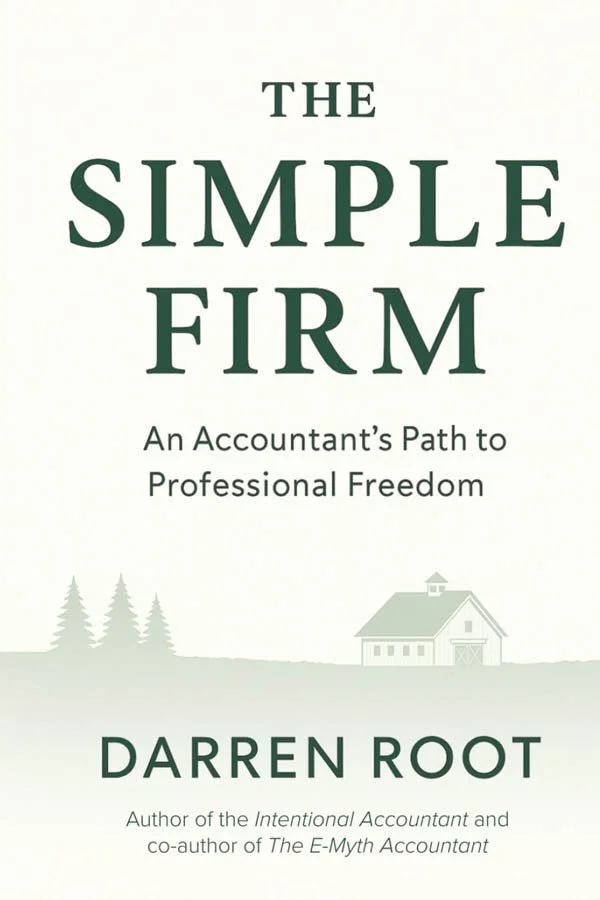
The Simple Firm: An Accountant's Path to Professional Freedom
During that same time, I wasn't bored enough, so I wrote a few books. I wrote The E-Myth Accountant with Michael Gerber. That was my first one. I stepped out and wrote The Intentional Accountant on my own a few years later. I released The Simple Firm, and we can talk a little bit more about that. Also during that time, I was the executive editor of CPA Practice Advisor magazine. Seven years I spent as the executive editor there.
There was a lot going on. Three small children, wife who wanted me to do things, so there was just a lot happening. It gave me some unique experiences in that I was running an accounting firm. I was talking to vendors all the time through the publication, and then I was talking to CPA firms across the country through a firm improvement organization. I had a unique perspective.
Why The Simple Firm? The Handbook The Profession Needed
You've done so much in your career of just helping the profession. For those of you that didn't read the first episode with Darren, he gave his backstory of how he even began his firm in the first place and why, and how he got into technology. In this episode, we do want to focus on your new book, The Simple Firm. Maybe we can start with why you wrote it in the first place at this point. What was it that started the whole concept for you?
I feel like I’ve learned a lot in the 35 years. In talking to accounting firms, I still feel like they struggle to get their head around their firm and to really run it from a templated way. Not that everything’s a template, but one of the things that Michael Gerber taught us is we needed to work on our businesses, we needed to create a business model, we shouldn't make it all about us. He and I ended up writing a book about that.
Over the 35 years, I realized that, yeah, it’s one thing to say you need a business model and you don't need to make it all about you and those things. It’s another thing to actually give people the formula, like the keys, and say, "Here’s how you do that. Here’s how I’ve coached hundreds, if not thousands, of accountants on a model. It’s not like it’s necessarily cookie-cutter, but there is a model for doing this if you're looking for professional freedom.” The tagline is about helping people find professional freedom and then I go into the book and I define a little bit about what I mean by professional freedom. The impetus was I felt like the profession really needed almost a handbook to do what I was advocating for years that they would do.
Unlocking Professional Freedom: The Four Essential Pillars
Let's dive in a little bit about what professional freedom means.
I’ll tell you what it means to me. It means that I have freedom of time. There are four things. The first one is freedom of time. Most accountants don't feel like they have the freedom of time. They feel like they're under deadlines and too much demand and all these things. The first step that I talk about in the book is how to develop freedom of time. The second one is freedom of money. If you get to choose how you spend your days and you have plenty of financial resources to support that, then the third step is to have freedom of relationships.
I’m not defining freedom. I’m defining professional freedom, the freedom to work with the kind of people that you want to work with, whether that is your team or the kind of clients that you want. Freedom of time, freedom of money, freedom of relationships. Those things, I think, are incremental. You wind up with freedom of purpose. Why do you want to do this? What’s the meaning that you have in all of this? If you have the freedom of time and you have plenty of financial resources and you're working with the people that you want to work with, the next step is the freedom to have an impact and have your purpose fulfilled partially through your organization. Does that make sense?
Yeah. How do you define those areas for yourself?
Freedom of time is probably one of the things I think people struggle with the most. For myself, it’s the freedom to allow my natural way that I want to work, to work. In the old days, it was me getting up at 5,30, 6,00 in the morning, heading out of the house in 30 minutes, starting with appointments at the office and doing that all day long and then continuing to crank that up during busy season.

The Simple Firm: We need to work on our businesses. We need to create a business model. We should not make it all about us.
That was not freedom of time. What I found was, for me personally, freedom of time was getting up, spending time, having coffee in front of the fireplace with my wife, working out, and then starting to work maybe at 10,00 in the morning. How do I develop an organization that gives me that kind of freedom to do those things?
That’s where it started for me. It was figuring out my rhythm. My rhythm never worked when I got up early. I still wake up early and I do a lot of things early, but I don't like to hit appointments at 8,00 in the morning. For me, I found at the end of the day, trying to work out and do all the things and hit kids' activities and all that stuff, it just never worked, and I always felt out of sync. Freedom of time is about finding what your rhythm is and what your sync is and then developing your company to support that.
Team Rhythms & Choices: Finding Freedom Of Time At Work
Before you move on, because I think this comes up a lot where everybody's got where their energy is at their highest and lowest in the day, but if you're working with other people and they're opposite from you, how do you still achieve what you're trying to do with your day?
You're talking about working with other people that are on your team or working with other people that are clients?
Yeah, or your boss or your colleagues, and you aren't good starting at 8,00 AM but your boss is. How does that work?
Stephen Covey’s first habit is the ability to be proactive, and that means the freedom to choose. We all have choices that we have to make. You may have a boss who demands that your butt is in the seat at 8,00. That may not change. You have the freedom to choose. You might not have the freedom in that situation to choose 10,00, but you have the freedom to choose what you do. In an industry where supply is low, I don't think you've ever had a better time to choose than maybe you do right now if you have talent.
I think the big thing, Amy, for me, is just recognizing what my rhythm is, because a lot of people who do have the ability to choose don't understand that they do have the ability to choose. They're like, "I’m stuck. My clients want to see me at 8,00. I’ve got 1,000 tax returns to review." I get all that. You still have a choice. You get to choose. Realizing that, and realizing that time is a part of that, I think, is really important. Otherwise, you're always out of balance. Would you agree with that?
Yeah. What I hear a lot, especially amongst accountants, is, "During busy season, I can't control it." An is that true or is it not true? Are those predetermined belief systems that we've had for a very long time and we're not actually stepping back and looking at what we can control versus what we can't to actually shift that paradigm so we can make it better?
In some respects, it depends on which seat you're sitting on the bus and the firm that you're working for. If you're a staff person who's doing tax and the owner is persistent on taking on every client that calls and needs more and more 1040 work, you're going to get in a strange situation that you may not enjoy. I, like you, talk to accounting firms daily, and most of them are struggling with staffing right now.

The Simple Firm: Freedom of time is about finding what your rhythm and sync is and then developing your company to support that.
Actually, it seems like all of them are struggling with staffing right now because the staff has figured out that they do get a choice. Choosing to continue to let tax season drain their souls is choices that people are not willing to make any longer, especially after COVID, I think. I just think life’s too short to allow somebody else to lead your life for you. I think people have to realize they have a choice, but just having a choice is not necessarily the big thing. Understanding what it is that you want is the big thing. Your choices will come easier from that.
Yeah, and I think doing some self-reflection so that even if you're not the owner but you're interviewing for a job, you know the right questions to ask. I think this one and your freedom of relationships, which is working with the right clients and right people, they go hand-in-hand if this is going to work.
They do. Charging enough is certainly important. Having enough financial freedom that you do get a choice you don't have to take on that next 1040 or that next client that's not a good fit or whatever the case might be. You need the financial resources to feel comfortable in making those choices, I think.
Freedom Of Money: The Difference Between Income And Personal Wealth
What is it with freedom of money in your life?
For me personally, I found that there was a big difference between a good income and personal wealth. Those things are different. For most of my career, I thought it was a good income, and then I had a good income and yet we would sometimes just do bigger things. That would go along, but I found that having significant resources beyond just paying your bills was a really freeing thing. I think the question that firms or people have to ask themselves is what resources do they need?
We all live different levels of lifestyle and spending and all that stuff, so this is different for everybody. At what level do you need to earn so that your choices aren't driven by the need of financial resources? I think it’s different for everybody, but for me personally, I unfortunately had horribly expensive taste, so it was a bigger number for me. I have lots of friends that’s not nearly the same. They're very comfortable. Finding that for yourself and being very comfortable in that, I think, is key.
Freedom of relationships, what does that mean for you?
Just the ability to be energized by who I’m working with, not feeling like I’m being drained, whether that’s a staff person or a client or, in mine and your case, hopping on an airplane to go do something that we really don't want to go do. It’s just different. We both do a lot of consulting now. Nowadays, I’m very picky about what cities I go to. It has to be really fun for me.
They have to have good hotels. I have to like the restaurants. I have to want to go there. I’m not going to hop on an airplane to fly to a town I’ve never heard of and then drive an hour and a half from the airport to get to some place to give a presentation to fifteen people. I’m just not doing it anymore. There was a time I did that a lot. It sucked the life out of me.
It’s like different seasons of your career what makes sense in this category.
Yeah, but you need the freedom of money to be able to choose. All this stuff again leads to professional freedom. What I’m after in the book is helping people understand what professional freedom means and then how do you get there.

The Simple Firm: You need the freedom of money to be able to choose.
Freedom Of Purpose: Choosing A Life Of Creativity And Impact
The last one, purpose?
For me, it’s having an impact. I was having coffee with one of my partners, John Mitchell, and we were talking about we're at different phases of life. I’m 65, so just signed up for Medicare. I’m not recommending it to anybody, but everybody I talk to now is like, "No, we don't take Medicare." John’s 50, so we're in different phases of life. He’s getting his kids in college and through high school and stuff. We're talking about what does purpose mean for him, what does purpose mean for me? I’m constantly revisiting that.
For me, I think mostly it’s impact, the impact I want to have. I want to focus on doing the things that I enjoy that really drive me, that have the most impact, which is probably why I wrote The Simple Firm. It’s one of those things that it took a year, it was an expensive process, I had editors here in New York that were really good that I hired. It was not like a money-making proposition necessarily, but it was about having impact and organizing thoughts. What I like to do now is just have an impact.
Side note, I live in town in Bloomington, Indiana, but there was this piece of property adjacent to me, it’s about 50 acres in all in town that was a horse farm. Think Lexington, Kentucky, with horses, black fences, and all that. It was owned by a guy who had beautiful horses. They raised horses there. He was a doctor and decided to sell. I decided to buy it because it’s right next to my house.
Now I’m looking at it trying to figure out, like John’s asking me at coffee, he said, "What is it you're going to do with it?" I said, "I’m going to start out just mowing it." I think it’s the creativity that I’m after. I want to build a beautiful neighborhood there. I do a lot of stuff with people at Ralph Lauren, so I’m very much into design and as we talked probably in our other episode, I started out that way. To me, this is an opportunity to have an impact and build a beautiful neighborhood where people can feel really good about it.
I think that’s an important piece of purpose or defining who we are. There’s an episode that I did with a therapist for women that were pregnant, so it was in utero that were having babies that something was going wrong in the pregnancy. It was to help them understand and bond before the baby was born. Really interesting person. One of the things he talked about was that we so much go through our lives defining ourselves by our titles and what we do, and it’s really about who are we really?
He was telling a story about when he was twelve, his father had a near-death experience. When he came back, he started studying Hinduism and was Buddhist and he was doing all sorts of things that weren't him. He sat Keith and his sister down and he asked them the question, "Who are you?" I think that is an interesting question because Keith initially answered, "I’m a football player," and he’s like, "What do you like about football," to really get into that.
At the end of the day, it was about like the strategy and the plays and how do you win, and he’s like, "So you're not just a football player, you're curious." that’s what you're describing here. No matter what season of your life, you're creative. If you can't fill that need to be creative, you're going to feel stuck and it’s such an important thing to uncover in your life that many people don't step back and tap into because sometimes, you're feeling off, you don't know why, and you're blaming everything around you, and it’s really you just needed to buy a horse farm and get creative again.
My wife is so happy about this because she thinks it’ll take some of the pressure off of all the projects I do around the house. We have a barn with a bar and a kitchen and it’s a great barn. We have events there for my company, Better Everyday. I’ve been renovating that. I’m flying home to meet Ralph Lauren’s team.
I’m a big fan of Ralph Lauren Home. I’m meeting them at our house and they’ve been redoing the entire house. We're wrapping up the project. My wife’s like, "You're always creating something." she’s super happy because now at least the mess that I create will be across the street and it won't be somebody wallpapering in our bedroom, which is what’s happening now. You're right, that creative side. Figuring out what drives us is really important.
That’s who you are at your core. When you created your accounting firm, when you created Rootworks, when you were an editor, you've done these books, it’s creation. That was something I’ve uncovered about myself as well I’m not a maintenance person. I actually get stuck when I’m in maintenance where I feel but some people are great as routine and that’s what they want, they don't want the messy middle.
You can create great things if you have people with different skillsets. At Rootworks, we had some great maintenance people. I just wasn't one of them.
That’s the important part of creating this firm and relationships to know what drives each person so you can make sure you're not trying to do all the things and taking up your time in that one category with things that aren't your strength and it depletes your energy. You might do it, you can do it well, but it depletes you because it’s not something that fuels you.
I think when I first really realized it well, I used to be in this program called the Strategic Coach, guy named Dan Sullivan. I was in Dan’s group for a number of years in Canada, in Toronto. When he started talking about this concept of unique ability, it took me a little while to figure out what my unique ability was because I’d been mired in reviewing tax returns and meeting with clients and doing all this stuff.
The Intentional Accountant: Your Roadmap for Building a Next Generation Accounting Firm
I’d already started Rootworks at that point in time. Came time where I wanted to write this book called The Intentional Accountant. It was during busy season. That’s when I think I first realized that I was very capable of preparing and reviewing tax returns, but it was sucking the life out of me and it wasn't the best use of my time. I wasn't going to have the biggest impact doing that. I went to my partner and said, "I really need to write this book during busy season." He’s like, "Go ahead." that was the first time I was like, "Stop doing something that is sucking the life out of me and find out what drives me."
The Simple Firm Blueprint: A Model For Turnkey Client Roadmaps
Maybe you can give us high-level of what this Simple Firm structure is and how this all works with what we've been talking about.
I think it starts with understanding that you have a choice. You do get a choice. Whether you're a team member or you're running a firm, you do get a choice. We live in a world or in a country where you get a choice. You get a choice. Once you understand that and again, in The 7 Habits of Highly Effective People from Stephen Covey, that’s habit number one. Habit number two from his book is, okay, you get a choice, now what do you want? What do you want this thing to look like? That’s where I think Michael Gerber’s E-Myth book comes in. What business model are you going to create? I spend a lot of time talking about how to create a business model for an accounting firm.
This isn't about doing simplistic work. It’s about simplifying the work that you do. Those are different. How do you create a model? All this is driving towards professional freedom as I’ve defined it. Start creating a business model that supports that. Business model is a huge part of the first components of the book. How do you put that together to make this in a lot of ways turnkey? I move on to what does it mean to start building out roadmaps to holistically serve customers? We've been talking about advisory services ad nauseam for many years now and most people still don't know how to do it very well.
Now we're on the precipice of AI having an impact. It’s starting to have a little bit of an impact, I wouldn't say it’s having a huge impact yet, but it’s day by day at this point. The best way I can describe this, Amy, is to have an example. I take on a new optometry practice. In the world that you and I both lived in in our past accounting lives, we probably took on that new optometry practice. We probably handed it off to a bookkeeper inside of our firm or a payroll person and we said, "We're supposed to do bookkeeping, payroll, and the corporate tax return for this person."
That’s what we would do. We'd go find the next one and we'd go find the next one. The problem is that optometry practice, the accounting firm’s always reactive to that optometry owner. We're always reacting to questions they ask or whatever. We're really never moving them forward. Yeah, do they need a retirement plan probably or should they have a health savings account probably, and maybe we help them with those things.
What I’m advocating for and teaching people how to do is how to create a roadmap. What are the 25 or 30 things that an optometry practice ought to do? I think back to the checklists we had back in the old audit days at Deloitte, there was a checklist. Do this, this, this, and this. Really, you should have a checklist for every type of client that you have. If you have an optometry practice, there’s a checklist of 25 or 30 things that optometry practice ought to be doing to feel holistically served. Retirement plan, health savings account, their kids' education plans. Go through the list of whatever those things are.
If we had a list like that and we could hand it to our team, our client managers or whatever. We had an advisory cadence in our firm that said every quarter we're going to meet with this client, we're going to keep moving them along, we have a checklist, we're moving them through this checklist. At some point in time, five years from now or whatever the period is, you've completed all these things and this client is feeling like, "You have just proactively helped me feel like I’m doing everything I’m supposed to be doing."
I don't think most firms know how to do that. Now, it’s never been easier. Just go ask ChatGPT, “What are the 25 things I ought to be doing for an optometry practice that looks like this,” it’s going to spit out 25 things. You might agree or disagree with a couple of them and you may have a couple to add to that, and that’s fine, but at least you're not starting with nothing.
In the old days, we handed it to somebody in the firm and they just reactively did what they've always done. What we're saying now is let's create a game plan for this optometry client or that dental client or whatever the client type may be. Let's actually have a game plan for every type of client that we serve. To me, that would have been life-changing when I was running my practice. Does that make sense?
Generalist Vs. Specialist: Verticalization In The Accounting Firm
Yeah, absolutely. How would this work? I can see on one hand if you're a generalist this could get unwieldy. Are you a proponent to verticalization or are you saying that this can work for any to be a generalist?
As I take people through the business model component, I think people should not be completely a generalist. I was a generalist. We did construction clients and manufacturing and service-based businesses. I was terrible at 4 out of 5 of those. We also did non-profit work and we did trust work and all these different things and I was terrible at most of that. Figuring out what I was actually really good at, that’s what ended up driving our economic engine was.
Figuring out what we were great at and not being like okay at everything and saying, "We want to focus on service-based businesses," which is what, I don't know, over 70% of the economy. It’s not like you're narrowing it down a lot. If you say, "I want to service I want to do client accounting, payroll, corporate tax, advisory for service-based businesses," okay, so that’s a big swath of stuff to do. Now at least you have a general plan.
Ask ChatGPT, what are the 25 best things you should do for a service-based business? That’s a place to start and start building roadmaps. What you're going to find over time is you will start having pockets of certain types of clients. Maybe it’s optometrists, maybe it’s dentists, maybe it’s landscapers. You're going to start developing some sub-niches in here, and that’s when you can go a little bit deeper even in your roadmaps. Just start with having some understanding that it’s not a free-for-all. You do have certain types of clients and kinds of work that you want to do, and build roadmaps for them. It’s better than starting with a blank sheet of paper, which is what we all do now. Does that make sense?
Within that roadmap from an advisory perspective, is the goal to get the relationship there, you're starting it with advisory?
Somebody comes in with a need, typically. Maybe they're just switching accountants and there’s this compliance work, which is getting client accounting, payroll, tax all the compliance stuff that has traditionally driven our economic engine. If that’s how somebody comes in the door, fantastic. Now you have a roadmap to lead them forward. You keep doing the compliance work because it drives your economic engine, but you have packages to lead them through your advisory services.
You start getting them into a cadence and start helping them do the things that they should be doing to maximize tax savings or business planning or whatever the case might be. I just think that you meet the client with wherever they are. Maybe they came in and they said, "I’m getting divorced and I need somebody to help me figure out what the value of this business is." Okay, that’s a place to start. Let's start there, and then you start building the relationship and maybe you add compliance at some point and maybe you add advisory once they understand what you're capable of doing.
The Ultimate Goal: Building A Happy, Sustainable Lifestyle Firm
What is it that you want people to know after reading this book? What do you hope the impact of it is?
There are so many people in the profession that I talked to, Amy, that I’ve just not loved their company, they're waiting until private equity or somebody emerges in with them or something happens so that they can stop. I want I want firms to feel like they can have a lifestyle firm if that's what they want.
A firm that supports them and allows them to do this for as long as they want to do it, but be really happy with it so that it supports the kind of Life they want to live. I want to give them a road map for doing that. They may end up deciding, they want to sell their private Equity or they want to merge up, or they want to pass it on to their kids, but at least they built something that gives them the freedom to do those things.
Anything you want to make sure that people walk away with or that you want to emphasize before we close out our conversation?
I think the thing I want to emphasize is there’s we have hundreds of firms doing this, so it’s just a choice that you make. There is a roadmap for doing this. It does take effort, you have to get started. I can't think of a better time when supply is low and demand is high to get focused on what it is that you want to accomplish. The other thing I would say is that technology is having a significant impact on your ability to create something special.
Thank you so much for being on to share this with the audience. There are so many things that I think will be helpful. We have all the information about Darren's book so that you can be able to access that if you'd like to purchase this book as well. Thank you so much for being on, Darren.
My pleasure, Amy. Thank you so much for having me.
---
Now for my Mindful Moments with my conversation with Darren. We have had Darren on before and he always has so many great stories and lessons for you to learn. Definitely look back at our prior episodes and learn about Darren Root’s story of how he got to be where he’s at. We briefly went over that he ran his own firm for 35 years and was the executive at CPA Practice Advisor. He moved into really running Rootworks, which had 1,000 CPA firm members, as well as being an author of The E-Myth Accountant and The Intentional Accountant.
I really got into why he is still doing this work and so passionate about it. He really has this new charge of Better Everyday of making sure that people find professional freedom. I think that's really important in understanding this, it isn't all freedoms, it's professional freedom. Professional meaning freedom of time, freedom of financial resources, freedom in relationships, and freedom of purpose and really finding meaning in your work.
Breaking that down of what we talked about, when we talk about freedom of time, it was really making sure that you had the freedom to allow the natural work that you need to do, but also work out, have time with your spouse, have time alone, do your hobbies, whatever that has to be, to find your rhythm. I know it took me a while to do this and feel confident enough about really being vigilant around boundaries on my calendar and making sure I didn't just give away time that was time for me or time that I needed to get my own work done or do a hobby.
Whatever that is, it was so important for me to schedule out my day by my priorities so that I could be proactive in my day versus reactive. I had a person that was in a workshop of mine that made the comment of, "I open up my computer and I just say, ‘Come at me.’" We don't want to feel that way. We want to make sure that we've created that professional freedom of time, that we're structured and not everything has to get done each day.
The other one was about freedom of financial resources and making sure you're charging enough and you're pricing properly and not just making a good income but creating personal wealth. There is a difference. I can tell you in the conversations that I have consulting with so many that this is a really tough thing for people to feel, especially in the accounting profession but all professions where you're giving of your time.
You're creating these relationships and you almost feel guilty for asking for more money instead of thinking about the person on the other side feeling like, "I can't imagine working with anyone else because of the value of this relationship." Actually putting a price tag to that time and value that you are creating in that relationship is so important.
Really understanding the resources you need to be at your best, whether that's technology, whether that's people and teams to be able to help you do the work that's most important. All of this is something to consider, especially as you're going into the new year of thinking about are you just skating by, or are you actually creating wealth for your future?
The third one was about freedom of relationships and to be energized with who you are working with. No matter what your industry is, you want to make sure that the clients that you decide to take on you're excited about. You're excited to do the work, you're excited to have the conversations, you're excited to work with the type of people that want to do that kind of work.
That creates energy and energy is contagious and it's important to not discredit that it's just work. This aligns with the fourth one that he talks about which is freedom of purpose. Really deciding what is it that brings meaning to your work creates energy. Making sure that the people that you work with align with the meaning of your work and that you're able to accomplish it. It’s really important for you to do that.
We talked about that as far as Darren and what is it that brings him purpose and that is creativity. If you read his life story on the other episode that I did with him, you'll know that he was actually in retail and in men's clothing and really enjoyed that way of life. Wherever he can find creativity, that's just purpose and meaning for him. It's important that we don't ignore those things that drive us.
If we are doing work and we're someone that likes to be creative and we're in routine and maintenance, we're going to be unhappy and not really understand why we are unhappy. It's important that we are uncovering what actually drives us, what creates energy for us so we're aligning the activities that we do with that, as well as making sure that the people that work for us are aligned with what drives energy for them as well.
We talked about the importance of having a roadmap. This couldn't be a better time of year to make sure that you're thinking through your goals and how you're going to get there and being proactive about it. Doing the right brainstorming in each of these areas and organizing it based on the impact that you can make by setting these goals in place and making sure that you're finding meaning and energy to create joy and happiness in your professional life.
I hope that you walk away from this understanding professional freedom and also you can pick up Darren's book. It's important that we don't forget that we have a choice and this isn't just put upon us. We have the opportunity to make a change. We have to focus on it, we have to actually write it out or say it, vocalize what those goals are, and understand a roadmap of how we can get there.
I hope you enjoyed this interview. I know I did. I always enjoy having Darren on and there's takeaways and actions that you can reflect upon for yourself and maybe take some notes where it's important so that you can have your best year yet, finding that professional freedom that you want so you can create the energy that you want for yourself, but be better for the people around you as well.
Important Links
Episode 153: Be Intentional - Build Something That Doesn't Only Rely On You With Darren Root
Episode 21: Who You Are: Find Your Capital "S" with Keith Bernardo
About Darren Root

Darren Root has spent over four decades in the accounting profession—as a firm owner, entrepreneur, and industry thought leader. A second-generation CPA and the founder of Rootworks and Better Everyday, Darren has dedicated his career to helping firm owners build businesses that don't just succeed, but support the lives they truly want to live. He's the author of The Intentional Accountant and co-author of The E-Myth Accountant, and his ideas have shaped the way thousands of firms think about technology, simplicity, and client experience. The Simple Firm is his most personal and practical work yet—a roadmap for accounting professionals who are ready to build a business on purpose.